
The short answer: confirm the moment, not just the clock reading
For a pickup during a repeated local hour, write the travel date, local pickup time and pickup city together. Ask the transportation provider to confirm which occurrence is intended and the exact meeting place in writing. Keep that agreed version with your itinerary. A quote request is not a booking. LimoVibes is a transportation discovery and inquiry platform; the provider confirms the vehicle, availability, price and booking terms.
The November 1, 2026 clock change is a useful example of why this matters. This guide explains the planning lesson for rides around a fall-back transition, rather than announcing an upcoming change.
Why 1:30 AM can refer to two different moments
In U.S. locations that observe daylight saving time, the fall transition moves the clock from 2:00 AM back to 1:00 AM. That repeats the 1 AM hour. NIST lists the 2026 transition as November 1 at 2:00 AM local time. The same displayed pickup time can therefore identify either of two moments unless the arrangement makes the intended occurrence clear.
The change is not nationwide without exception. The U.S. Department of Transportation lists locations that do not observe daylight saving time, including Hawaii and most of Arizona. Check the actual pickup location; do not assume that a rule for Los Angeles applies to every U.S. trip.
Worked example: Los Angeles on November 1, 2026
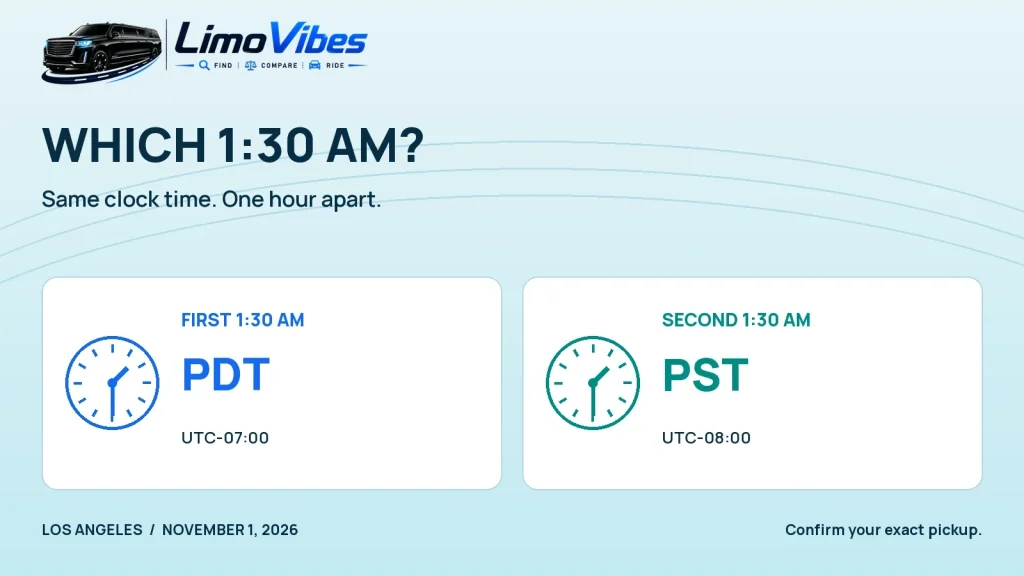
These two example pickup times have the same clock reading but are one hour apart:
First 1:30 AM: Sunday, November 1, 2026, in Los Angeles, during Pacific Daylight Time (PDT, UTC-07:00). This corresponds to 08:30 UTC.
Second 1:30 AM: Sunday, November 1, 2026, in Los Angeles, during Pacific Standard Time (PST, UTC-08:00). This corresponds to 09:30 UTC.
The example uses local time-zone rules for America/Los_Angeles. It is a worked timing example, not a record of a customer trip. For a real pickup, ask the provider to confirm the intended date, time zone and occurrence. Avoid using a time-zone abbreviation alone without the pickup city and date.
Your five-part pickup confirmation checklist
1. Date: state the full pickup date. For travel around midnight, distinguish the departure date, arrival date and actual vehicle meeting date.
2. Local time and place: state the requested pickup time and the city or airport where the pickup happens. Keep the full address, terminal or agreed meeting-point description with the itinerary.
3. Repeated-hour detail: if the local hour repeats, clarify first or second occurrence with the provider. Include the confirmed time-zone offset when helpful, rather than asking the traveler to infer it.
4. Meeting arrangement: confirm where and how the traveler and provider will meet, along with the agreed contact method and what to do if either party is delayed.
5. Written agreement: retain the provider's confirmation and the steps required to reserve. Make sure the traveler, coordinator and provider use the same final version.
A message you can adapt for the provider
Please confirm my pickup for Sunday, November 1, 2026, at the second 1:30 AM in Los Angeles, after the clock returns to Pacific Standard Time (PST, UTC-08:00). Please also confirm the pickup address or meeting point and the steps needed to reserve. If you understand a different date or time, please clarify it before confirming the arrangement.
This is an example message for the date above. Replace every trip detail with the actual agreed arrangement. Do not copy its date, city or time zone into an unrelated itinerary.
Airport arrivals and coordinator handoffs need the same precision
For an airport trip, keep the airline's current itinerary and flight number with the request. Explain whether the requested time means the flight's scheduled arrival, the traveler's expected readiness or the agreed vehicle meeting time. Those are different planning details. Ask the provider how changes, waiting and contact will be handled.
A coordinator should share one confirmed pickup record with the traveler and the provider. If a calendar entry or phone display looks different after a clock change, resolve that difference against the agreed local arrangement before the ride. An automatic device update does not establish what the provider has confirmed.
For the wider decision—operator, vehicle fit, total price and cancellation terms—explore the LimoVibes trip-planning guides. This article focuses on the repeated-hour pickup detail.
Frequently asked questions
Does every U.S. pickup have a repeated hour?
No. It depends on the pickup location and whether it observes daylight saving time. Use current rules for that location and date.
Is writing PST or PDT enough?
Include the full date, local time and pickup city too. During a repeated hour, get the intended occurrence explicitly confirmed by the provider.
Does a quote request reserve the ride?
No. A request communicates what you are seeking. The provider confirms availability, the vehicle, price, booking terms and the steps required to reserve. Keep the actual confirmation.
Is the checklist useful after November 1?
Yes. The example is dated, but confirming the date, local time, place and written agreement is useful for future clock changes and trips across time zones.
One next step: keep one clear pickup plan
Confirm the exact pickup moment and meeting place with your transportation provider, then retain the agreed version with your travel details. LimoVibes helps people discover and compare transportation providers and send inquiries; the provider confirms the transportation arrangement.